
Stop random acts of marketing. Start building a connected, measurable and continuously improving growth system. Developed by Jeff Javierto, Growth Marketing Director and Author of 7GrowthSigma™, the framework provides a structured approach to understanding markets, capturing demand, developing buyer confidence, generating qualified opportunities, expanding customer relationships and measuring business impact.
7GrowthSigma™ is designed to move organisations beyond disconnected marketing campaigns and isolated performance metrics. It connects market intelligence, marketing execution, customer acquisition, commercial performance and continuous improvement within one integrated operating system.
It is particularly relevant to industrial, manufacturing, engineering and other complex B2B environments where purchasing decisions involve multiple stakeholders, technical evaluation, commercial justification, risk assessment and extended sales cycles. Its underlying principles can also be applied across other industries and business models.
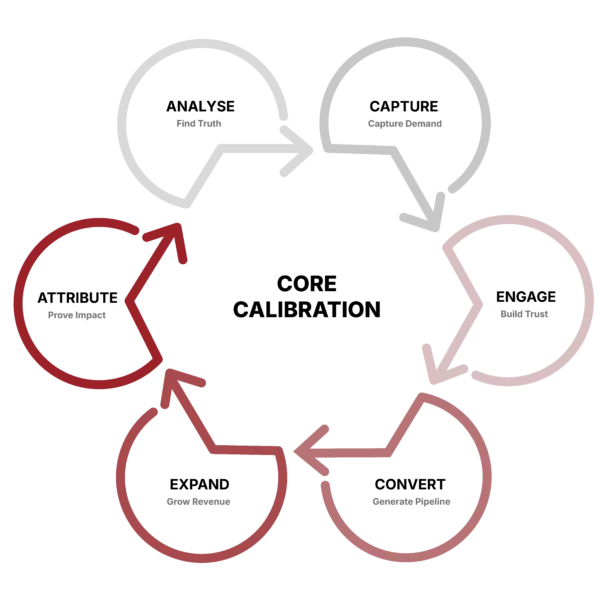
The framework consists of six interconnected phases: Analyse, Capture, Engage, Convert, Expand and Attribute (ACE-CEA), governed by a continuous improvement core: Calibrate (C).
Its purpose is straightforward: help organisations make better growth decisions, attract the right customers, create stronger commercial opportunities, improve customer value and understand what contributes to business performance.
Understanding the 7GrowthSigma™ Architecture
7GrowthSigma™ is structured around six operational phases and one governing core.
The six phases represent the activities required to build and manage a complete growth system. Calibrate operates across all six phases, ensuring that performance is continuously evaluated, learning is applied and decisions are improved over time.
Component | Focus | Strategic purpose |
Analyse | Find the truth | Understand the market, customers, business economics and performance constraints. |
Capture | Capture demand | Establish visibility and reach buyers through relevant acquisition channels. |
Engage | Build trust | Develop buyer understanding, confidence and consideration through meaningful interactions. |
Convert | Generate pipeline | Turn interest into qualified enquiries, RFQs and commercial opportunities. |
Expand | Grow accounts | Strengthen customer relationships, retention, advocacy and account value. |
Attribute | Prove impact | Connect marketing activity and investment to measurable commercial outcomes. |
Calibrate (Core) | Improve the system | Continuously measure, learn, prioritise and optimise performance across every phase. |
The architecture follows a connected progression:
Understand → Attract → Build Confidence → Convert → Expand → Measure → Improve
This is not a rigid, one-directional funnel. Buyers can enter at different points, move between stages, revisit earlier decisions or engage through multiple channels. Existing customers may also generate new opportunities through repeat purchases, referrals and account expansion.
The framework therefore operates as a closed loop rather than a linear campaign sequence.
Phase 1: ANALYSE
Find the Truth. Establish the Growth Baseline.
Growth begins with understanding the business before deciding what marketing activities to execute.
Analyse establishes the strategic and commercial foundation of the system. It examines the organisation’s market position, ideal customer profile, buying environment, customer economics, competitive landscape and existing marketing and sales performance.
The objective is to identify where growth opportunities exist, where commercial value is being lost and which constraints should be addressed first.
Core areas of analysis
Key deliverables
Performance indicators
ICP fit, qualified market demand, customer acquisition cost, customer profitability, funnel conversion rates, sales-cycle duration, lead quality and identified growth constraints.
Strategic outcome: A clear, evidence-based understanding of where the business stands, which customers it should pursue and where investment can create the greatest potential impact.
Phase 2: CAPTURE
Capture Demand. Build Visibility Where Buyers Search.
Once the organisation understands its market and ideal customers, it must establish visibility and reach the people who can influence or initiate purchasing decisions.
Capture focuses on making the business discoverable and accessible across the channels and platforms buyers use to identify solutions, research suppliers and evaluate alternatives.
The objective is not simply to generate traffic. It is to attract relevant attention from the right markets and create opportunities for meaningful engagement.
Core areas of execution
Key deliverables
Performance indicators
Qualified organic traffic, high-intent website visits, search visibility, relevant keyword coverage, paid campaign performance, target-account reach, cost per lead and cost per qualified enquiry.
Strategic outcome: The business becomes more visible and accessible to relevant buyers, creating opportunities to attract demand through channels aligned with their purchasing behaviour.
Phase 3: ENGAGE
Build Trust. Develop Buyer Confidence.
Visibility creates the opportunity to be considered. Trust gives buyers a reason to continue.
Engage focuses on developing the confidence, understanding and commercial credibility required for buyers to evaluate a business and its solutions.
This is particularly important in complex B2B markets, where purchasing decisions may involve technical specifications, operational requirements, financial justification, supplier credibility and perceived implementation risk.
The objective is to help buyers make informed decisions by providing relevant information, evidence and meaningful interactions throughout their evaluation journey.
Core areas of execution
Key deliverables
Performance indicators
Content engagement, returning visitors, meaningful interactions, email engagement, lead progression, marketing-qualified leads (MQLs), sales acceptance and buyer engagement across relevant channels.
Strategic outcome: Buyers develop a stronger understanding of the organisation’s expertise, value proposition and ability to address their requirements, supporting more informed purchasing decisions.
Phase 4: CONVERT
Generate Pipeline. Turn Interest into Qualified Opportunities.
Marketing activity must ultimately contribute to meaningful commercial opportunities.
Convert focuses on reducing friction between buyer interest and commercial action. It connects acquisition, engagement, website experience, enquiry management, lead qualification and marketing-to-sales handover.
The objective is to improve the quality and conversion of opportunities entering the commercial pipeline, rather than simply increasing the number of enquiries.
Core areas of execution
Key deliverables
Performance indicators
Website conversion rate, qualified enquiries, RFQ volume and quality, lead acceptance, MQL-to-SAL progression, sales-qualified leads (SQLs), cost per qualified opportunity, opportunity creation and sourced or influenced pipeline.
Strategic outcome: More relevant buyer interest progresses into qualified commercial opportunities through a clearer, more effective and measurable conversion process.
Phase 5: EXPAND
Grow Accounts. Increase the Value of Customer Relationships.
Sustainable growth does not end when a new customer is acquired.
Expand recognises that existing customers represent an important source of continued commercial value. Strong customer relationships can create opportunities for repeat purchases, additional applications, cross-selling, upselling, referrals and long-term retention.
The objective is to develop the value of existing customer relationships while supporting customer satisfaction and sustainable business performance.
Core areas of execution
Key deliverables
Performance indicators
Customer retention, repeat purchase rate, customer lifetime value, existing-customer gross profit, expansion pipeline, cross-sell and upsell performance, customer referrals and customer engagement.
Strategic outcome: The organisation develops stronger customer relationships, improves retention and creates additional opportunities for sustainable growth from its existing customer base.
Phase 6: ATTRIBUTE
Prove Impact. Connect Marketing Performance to Business Outcomes.
Marketing performance must be understood in commercial terms.
Attribute establishes the measurement and accountability structure that connects marketing investment and activity to lead generation, pipeline development, customer acquisition and business outcomes.
It moves reporting beyond isolated channel metrics by examining how marketing contributes to the wider customer and commercial journey.
The objective is to understand what is working, what is not, where investment is producing value and how marketing performance relates to business results.
Core areas of execution
Key deliverables
Performance indicators
Marketing-sourced pipeline, marketing-influenced pipeline, qualified opportunities, customer acquisition cost, cost per opportunity, marketing investment efficiency, conversion progression, customer acquisition economics and marketing contribution to closed-won business.
Strategic outcome: Leadership gains a clearer understanding of marketing’s contribution to commercial performance and can make better-informed decisions about investment, resource allocation and growth priorities.
CALIBRATE: The Governing Core
Continuous Improvement Across the Entire Growth System.
Calibrate is the governing core of 7GrowthSigma™.
It is not a seventh operational phase or a final step performed after Attribute. It operates continuously across all six phases, ensuring that decisions are informed by performance, evidence, customer feedback and changing business conditions.
Without calibration, organisations risk repeating activities that no longer work, investing in underperforming channels, overlooking changing customer requirements and measuring performance without improving it.
Calibrate turns the framework into a learning system.
The Calibrate improvement cycle
This cycle repeats continuously.
How Calibrate governs each phase
Phase | Calibration focus |
Analyse | Reassess market conditions, ICP accuracy, customer economics and growth priorities. |
Capture | Refine channel allocation, search visibility, audience targeting and acquisition efficiency. |
Engage | Improve messaging, content relevance, buyer education and lead nurturing. |
Convert | Optimise website experience, lead quality, qualification and conversion pathways. |
Expand | Improve retention, customer engagement, account development and expansion opportunities. |
Attribute | Strengthen tracking, data quality, attribution and commercial reporting. |
Strategic outcome: The organisation becomes more responsive, informed and efficient over time. Every performance cycle creates learning that can improve the next.
The Operating Principles Behind 7GrowthSigma™
The framework is built on a set of principles that guide its application across different organisations, markets and business environments.
Marketing activities should be driven by business objectives, customer understanding and market evidence, not by trends, tools or isolated channel opportunities.
The objective is not to generate the greatest number of leads. It is to attract and develop customers whose commercial value justifies the cost and effort of acquisition and service.
Effective marketing requires an understanding of customer requirements, decision-making processes, buying committees, objections and perceived risks.
Organisations need to build awareness and consideration while also remaining visible when buyers actively search for products, services and solutions.
Technical expertise, transparent communication, credible evidence and consistent customer experiences reduce uncertainty and support purchasing decisions.
A campaign cannot compensate indefinitely for a poor website experience, unclear value proposition, ineffective enquiry process or delayed sales follow-up.
Retention, repeat purchases, referrals and account expansion should be considered alongside new customer acquisition.
Traffic, impressions, engagement and leads are useful indicators, but they must be interpreted in the context of qualified opportunities, customer economics and commercial performance.
Marketing and Sales have distinct responsibilities, but they must share definitions, feedback, visibility and agreed processes across the customer journey.
Markets, customer behaviour, competition, technology and business conditions change. Growth systems must adapt through structured measurement, experimentation and learning.
The 7GrowthSigma™ Performance and KPI Architecture
A complete growth system requires more than a collection of marketing metrics. It needs a measurement hierarchy that connects activity to customer behaviour, commercial progression and business results.
7GrowthSigma™ distinguishes between three levels of measurement.
Level 1: Activity and leading indicators
These measure the execution and early performance of growth activities.
Examples include:
Level 2: Commercial progression indicators
These measure whether marketing activity is creating meaningful movement towards business opportunities.
Examples include:
Level 3: Business outcome indicators
These measure the wider commercial results to which marketing may contribute.
Examples include:
Not every organisation will use every metric. KPI selection should reflect the business model, sales cycle, data maturity, customer economics and strategic priorities.
A critical distinction: Marketing can own acquisition strategy, campaign execution, lead generation, conversion optimisation and marketing measurement. Sales typically owns sales qualification, quotation management, negotiation and closing. Both functions should share accountability for improving the customer journey and commercial outcomes.
Attribution should also be interpreted carefully. Marketing-sourced pipeline and marketing-influenced pipeline are different measurements. Neither automatically proves that marketing alone caused a sale. Reliable reporting should recognise multiple touchpoints, sales activity, existing relationships and other commercial influences.
Applying 7GrowthSigma™ Across Different Business Environments
7GrowthSigma™ is a management framework, not a fixed campaign template. Its principles remain consistent, but implementation should be adapted to the organisation’s market, customer behaviour, sales process, commercial model and operational capabilities.
Industrial, manufacturing and engineering B2B
In complex B2B environments, the framework should account for:
For these businesses, marketing performance should be evaluated beyond website traffic and lead volume. Qualified RFQs, opportunity progression, quotation quality, sales-cycle performance and customer economics are important measures.
Professional and business services
The framework can be applied to service-based organisations by placing greater emphasis on expertise, reputation, relationship development, consultation enquiries, client acquisition economics, retention and referrals.
Start-ups and growing organisations
For organisations with limited resources, the framework can establish priorities, identify the most important acquisition constraints, validate market demand and create a measurement foundation before scaling investment.
The principle is consistent: adapt the execution to the business, but maintain the connection between market understanding, customer acquisition, conversion, customer value, measurement and continuous improvement.
Implementing the Framework: From Strategy to Execution
7GrowthSigma™ can be implemented as a strategic planning model, a marketing operating system or an organisation-wide growth management framework.
A practical implementation should follow a structured process.
Step 1: Establish the business baseline
Assess commercial objectives, target customers, market conditions, customer economics, existing marketing performance and sales processes.
Step 2: Identify the highest-priority growth constraints
Determine whether the main challenge is market visibility, demand generation, buyer confidence, conversion, customer retention, measurement or a combination of factors.
Step 3: Define phase-specific objectives
Establish what each phase must achieve and how its contribution will be evaluated.
Step 4: Prioritise initiatives and resources
Select the activities, channels, technology, people and investment required to address the identified constraints.
Step 5: Establish shared processes and accountability
Define ownership, responsibilities, lead-stage definitions, handover procedures, reporting requirements and collaboration between Marketing, Sales, Operations and Leadership.
Step 6: Execute and measure
Implement the agreed growth initiatives while monitoring leading indicators, commercial progression and business outcomes.
Step 7: Calibrate and improve
Use performance insights and customer feedback to refine strategy, reallocate resources and improve the system continuously.
Recommended management cadence
Review frequency | Management focus |
Weekly | Campaign execution, acquisition performance, lead quality, conversion issues and immediate optimisation. |
Monthly | Funnel progression, qualified opportunities, channel performance, marketing investment and sales feedback. |
Quarterly | Strategic growth priorities, customer economics, market changes, account development and resource allocation. |
Annually | Business objectives, market positioning, investment strategy, growth model and organisational capability. |
The review cadence should reflect the organisation’s sales cycle and data maturity. A business with long project-based sales cycles should not judge strategic performance solely on short-term campaign results.
The Relationship Between 7GrowthSigma™ and the Marketing Mix
7GrowthSigma™ complements established marketing and management concepts rather than replacing them.
For example, the traditional 7 Ps of Marketing provides a broad diagnostic lens for evaluating how an organisation creates, communicates and delivers value:
7GrowthSigma™ addresses a different management question: how does the organisation turn market understanding and its value proposition into a measurable, continuously improving growth system?
The 7 Ps can inform the Analyse phase by helping organisations examine their offer, pricing, distribution, promotion, people, processes and evidence of value. Findings can then inform the strategic priorities and execution across the six phases.
Similarly, concepts such as customer journey mapping, demand generation, account-based marketing, lifecycle marketing, conversion rate optimisation, marketing attribution and continuous improvement can be integrated into the framework.
The distinction is important:
The 7 Ps examines the marketing mix. 7GrowthSigma™ organises the growth system.
It provides a structure for connecting strategic diagnosis, market acquisition, buyer engagement, conversion, customer expansion, measurement and improvement.
What Makes 7GrowthSigma™ Different?
Many organisations approach marketing through individual channels, campaigns or departments. They may invest in SEO, paid advertising, content, social media, email, website development and CRM without a unified structure connecting those activities to commercial objectives.
7GrowthSigma™ addresses this fragmentation by providing a connected management architecture.
Its distinguishing characteristics include:
Six operational phases connect market intelligence, demand generation, customer engagement, conversion, account expansion and performance measurement.
The framework evaluates marketing in the context of qualified opportunities, acquisition economics, customer value and business performance.
Growth includes both acquiring new customers and increasing the value of existing relationships.
Marketing, Sales, Operations and Leadership are considered interconnected contributors to the customer and commercial journey, with distinct responsibilities.
The framework connects marketing indicators to funnel progression, pipeline development and business outcomes while recognising the limitations of attribution.
Calibrate governs the entire system, ensuring that measurement leads to decisions and decisions lead to tested improvements.
The framework establishes consistent management principles while allowing implementation to reflect different markets, customer journeys, sales cycles and commercial requirements.
The Ultimate Objective: Build a Growth System, Not Just a Marketing Function
The value of 7GrowthSigma™ is not found in completing six separate phases. It is found in how they work together.
Analyse establishes where and how the organisation can grow.
Capture makes the organisation visible to relevant buyers.
Engage develops understanding, credibility and trust.
Convert turns buyer interest into qualified commercial opportunities.
Expand strengthens customer relationships and increases long-term value.
Attribute measures performance and connects marketing activity to commercial outcomes.
Calibrate continuously improves every phase.
Together, they create a structured approach to managing growth from market understanding through customer acquisition and expansion to measurable business performance.
The framework does not assume that every organisation needs more marketing activity. Sometimes the greatest opportunity is improving customer targeting. Sometimes it is strengthening technical content, fixing a conversion barrier, improving lead response, retaining existing customers or correcting unreliable measurement.
The discipline is to identify the real constraint, address it with the right intervention and validate the result.
That is the central principle of 7GrowthSigma™: growth should be understood, engineered, measured and continuously improved.
About the Author
Jeff Javierto is a Growth Marketing Director specialising in B2B demand generation, lead acquisition and growth performance, with experience across industrial, engineering, manufacturing and technical business environments.
He developed 7GrowthSigma™ to provide a structured approach to connecting marketing strategy, acquisition, conversion, customer expansion and commercial measurement.
His work focuses on building measurable growth systems that connect market visibility and buyer engagement to qualified opportunities and stronger business performance.
7GrowthSigma™
Six phases. One governing core. Zero guesswork.
Analyse. Capture. Engage. Convert. Expand. Attribute.
Governed by Calibrate. Designed for continuous growt