
Quick Answer
Yes. The 7 Ps of marketing — Product, Price, Place, Promotion, People, Process, and Physical Evidence — remain relevant in the digital age.
What has changed is not the underlying framework, but the environment in which marketers apply it.
The original marketing mix was developed to help businesses think systematically about the decisions that shape a customer’s experience and influence demand. Digital marketing, social media, ecommerce, automation, data analytics, mobile technology, and AI have introduced new channels and behaviours, but they have not eliminated those fundamental decisions.
In fact, the 7 Ps can be more useful in a fragmented digital environment because they force marketers to look beyond individual channels.
A business can have excellent SEO and still have a weak product. It can generate thousands of leads and still have a poor sales process. It can run successful advertising campaigns and still lose customers because its pricing, onboarding, service, or proof of credibility is inadequate.
The 7 Ps provide a broader question:
Are all the major elements of the customer experience and marketing strategy working together?
That is why the framework has endured.
The mistake is not using the 7 Ps. The mistake is treating them as a static checklist from another era rather than adapting each P to how customers discover, evaluate, purchase, use, and recommend products today.
Why the 7 Ps Still Matter
Marketing changes constantly.
New platforms appear. Search behaviour changes. Advertising formats evolve. Algorithms change. Customers move between websites, social media, marketplaces, communities, review platforms, email, video, messaging apps, and increasingly AI-powered interfaces.
It can therefore be tempting to believe that every major technological shift requires an entirely new marketing framework.
Usually, it doesn’t.
A new channel is not the same thing as a new marketing principle.
Google Search did not eliminate the need for a strong product. Social media did not make pricing irrelevant. Ecommerce did not eliminate people or processes. AI does not remove the need for trust.
Instead, technology changes how the seven elements are delivered, experienced, measured, and connected.
That distinction is important.
The 7 Ps are not a digital marketing strategy by themselves. They are a strategic framework for examining the broader marketing system.
Digital marketing then becomes part of how that system operates.
- Product: The Product Is More Than the Core Offering
Product remains the foundation of marketing.
If the product does not solve a meaningful problem or deliver sufficient value, better advertising can only amplify the weakness.
In a digital environment, however, the definition of the product experience has expanded.
For many businesses, customers interact with far more than the core physical product or service.
They may encounter:
- A website before contacting the company
- Product comparison tools
- Online configurators
- Demonstration videos
- Technical documentation
- Mobile applications
- Customer portals
- Digital onboarding
- Knowledge bases
- Online support
- Product dashboards
- Automated notifications
- Communities and user resources
For a SaaS company, for example, the product includes the software itself, but the customer experience may also include onboarding, documentation, integrations, account management, support, and the usability of the interface.
For a manufacturer, the product may increasingly be supported by digital monitoring, technical documentation, configuration tools, remote support, or connected systems.
This means marketing and product teams need to work more closely together.
Marketing cannot simply ask, “How do we promote this product?”
A better question is:
“What experience are we actually asking customers to buy?”
Product strategy therefore includes functionality, quality, usability, packaging, service, differentiation, and the broader experience surrounding the offering.
Digital technology has expanded the product experience. It has not changed the fundamental principle: the product must create meaningful value for the customer.
- Price: Value, Perception and Willingness to Pay
Price has always been more than a number.
It communicates value, affects positioning, influences demand, determines margins, and shapes customer expectations.
Digital channels have made pricing more visible and easier to compare.
Customers can often compare competitors within minutes. They can research alternatives, read reviews, examine specifications, compare subscription plans, and evaluate total costs before speaking to a salesperson.
This increases the importance of pricing strategy.
A strong digital marketing strategy therefore needs to consider:
- Price positioning
- Customer willingness to pay
- Perceived value
- Competitive alternatives
- Discounts and promotions
- Subscription or recurring pricing
- Bundling
- Pricing transparency
- Total cost of ownership
- Commercial terms
- Value communication
Technology can also make pricing more data-informed. Businesses can analyse purchasing behaviour, conversion rates, customer segments, demand patterns, and competitive information.
But technology does not change the central question:
Does the customer believe the value received justifies the price paid?
This is particularly important in B2B marketing.
A lower price does not automatically create a stronger proposition. Buyers may be evaluating reliability, implementation costs, productivity, risk, support, lifespan, compliance, downtime, and total cost of ownership.
Marketing’s responsibility is not simply to make a price look attractive.
It is to make the value behind the price understandable.
- Place: Where Customers Discover, Evaluate and Buy
Place is one of the Ps that has changed most visibly.
Traditionally, Place referred to distribution: where products were sold, how they reached customers, and which locations or intermediaries were involved.
Today, Place encompasses the entire ecosystem through which customers can discover, evaluate, access, purchase, and receive an offering.
That can include:
- Physical stores
- Sales representatives
- Distributors
- Ecommerce websites
- Marketplaces
- Search engines
- Social platforms
- Mobile applications
- Industry directories
- Review platforms
- Communities
- Messaging platforms
- Digital events
- AI-powered search and answer interfaces
This makes Place closely connected to customer journey design.
Consider a customer searching for an industrial solution.
They might first encounter a company through a search engine, then visit its website, watch a technical video, download a specification sheet, compare competitors, ask an AI assistant for additional information, speak with a sales representative, and eventually purchase through a distributor.
The company has not changed its product.
But the places through which the customer experiences the company have multiplied.
This is why modern marketers need to think beyond simply asking:
“Where should we advertise?”
The more strategic question is:
“Where does our customer go to solve this problem, and are we present there with useful, credible information?”
That is the modern interpretation of Place.
- Promotion: From Campaigns to Integrated Communication
Promotion is perhaps the P most commonly associated with marketing.
It includes the communication activities used to create awareness, generate interest, influence consideration, and encourage action.
Digital marketing has dramatically expanded the promotional toolkit.
Businesses can now use:
- Search engine optimisation
- Paid search
- Paid social
- Organic social media
- Email marketing
- Content marketing
- Video
- Digital PR
- Influencer marketing
- Partnerships
- Webinars
- Events
- Retargeting
- Account-based marketing
- Marketing automation
- Community engagement
More recently, marketers must also consider how their brands and content appear within AI-mediated discovery and answer experiences.
But more channels do not automatically mean better marketing.
In fact, fragmentation makes strategic discipline more important.
The objective should not be to publish everywhere.
It should be to understand:
- Who are we trying to reach?
- What problem are they trying to solve?
- What information do they need?
- Where do they look for that information?
- What message will be relevant at that stage?
- What evidence will make the message credible?
- What action should they take next?
This is where promotion connects with the rest of the marketing mix.
Great promotion cannot compensate indefinitely for poor positioning, weak products, confusing pricing, or a broken customer experience.
Promotion creates attention.
The rest of the marketing system determines what happens to that attention.
- People: Technology Does Not Eliminate Human Influence
One of the most important developments in modern marketing is automation.
Businesses can automate email sequences, lead scoring, customer communications, reporting, content workflows, chat interactions, personalisation, and numerous operational tasks.
But automation does not make People less important.
It changes where human involvement creates the most value.
Customers still want knowledgeable people when situations are complex, high-risk, emotional, expensive, or ambiguous.
This is especially evident in B2B marketing.
A buyer evaluating an industrial system, enterprise platform, engineering solution, or professional service may need technical expertise, consultation, reassurance, implementation guidance, or help navigating internal stakeholders.
Automation can handle routine interactions.
People provide judgement, expertise, empathy, accountability, and relationship-building.
The strongest organisations therefore do not necessarily ask:
“What can we automate?”
They ask:
“What should be automated, and where does human involvement create disproportionate value?”
That distinction matters.
A chatbot that quickly answers a simple question may improve the experience.
A chatbot that prevents a customer from reaching a knowledgeable person when the problem is complicated can damage it.
Technology should strengthen the human experience rather than automatically replace it.
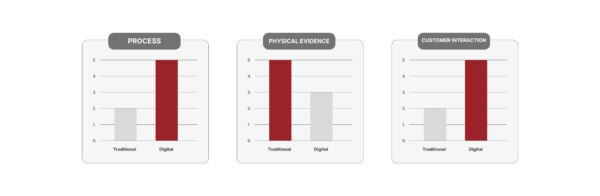
- Process: The Experience Behind the Brand
Customers rarely see every internal process.
They still experience the consequences.
Process includes the systems and procedures through which a company delivers its products and services.
That can include:
- Ordering
- Checkout
- Lead handling
- Sales qualification
- Quotation
- Payment
- Delivery
- Installation
- Onboarding
- Customer support
- Returns
- Renewals
- Complaint resolution
- Communication
- After-sales service
Digital technology has created enormous opportunities to improve these processes.
Customers can receive instant confirmations, track orders, schedule appointments, access documents, update account information, resolve simple support issues, and communicate through digital channels.
But process optimisation should not be confused with maximum automation.
A process is successful when it makes the customer journey clearer, easier, faster, and more reliable.
Sometimes automation achieves that.
Sometimes a human does.
The goal is not automation for its own sake.
The goal is reducing unnecessary friction while preserving the interactions that customers actually value.
This also has an internal marketing implication.
A company cannot consistently promise a premium customer experience if its internal processes make delivering that experience difficult.
Marketing, sales, operations, customer service, and technology therefore need to work together.
- Physical Evidence: Trust in a Digital World
Physical Evidence is often the least understood of the 7 Ps.
The concept originally addressed the tangible cues that help customers judge an otherwise intangible service.
A professional office, uniform, brochure, packaging, signage, facilities, or physical environment could provide evidence of quality and credibility.
In a digital environment, much of that evidence has moved online.
Customers may judge a business through:
- Website quality
- Product photography
- Case studies
- Reviews
- Testimonials
- Certifications
- Technical documentation
- Demonstrations
- Security information
- Company profiles
- Thought leadership
- Customer logos
- Awards
- Social proof
- Staff expertise
- Brand consistency
These are not merely cosmetic assets.
They reduce perceived risk.
This is particularly important when customers cannot fully evaluate the quality of an offering before purchasing it.
Consider a professional service provider. The customer may not be able to assess the underlying service immediately. Instead, they use available evidence — credentials, case studies, reviews, content, recommendations, website quality, and conversations with the team — to estimate whether the provider is trustworthy.
The same principle applies online.
The “physical” part of Physical Evidence has become broader than physical objects.
It is better understood as:
What tangible or observable evidence does the customer have that supports our claims?
That question remains extremely relevant.
How the 7 Ps Work Together
The greatest value of the framework comes from looking at the Ps collectively rather than optimising each one independently.
Imagine a company with:
- Excellent advertising
- Strong organic search visibility
- High website traffic
- Competitive pricing
- A well-designed product
Yet customers still do not convert.
The problem may not be Promotion.
Perhaps the product is difficult to understand.
Perhaps the buying process is complicated.
Perhaps there is insufficient evidence of credibility.
Perhaps sales follow-up is slow.
Perhaps the onboarding experience creates friction.
Perhaps the company is reaching the wrong audience.
This is why channel-level marketing metrics can sometimes hide strategic problems.
Traffic, impressions, clicks, engagement, and leads are useful measurements, but they do not tell the whole story.
The 7 Ps encourage marketers to examine the entire commercial system.
A useful way to think about the framework is:
Product creates value.
Price communicates and captures value.
Place makes the offering accessible.
Promotion creates awareness and consideration.
People deliver expertise and experience.
Process makes the experience work.
Physical Evidence makes the promise credible.
When these elements reinforce one another, marketing becomes much more than promotion.
It becomes a coherent customer experience.
Do We Need an 8th P?
There have been many proposed additions to the marketing mix over the years.
Some frameworks introduce concepts such as productivity, performance, partnerships, positioning, or purpose.
These ideas can be useful depending on the context.
But there is no universal requirement for an eighth P.
The strength of the 7 Ps is that they provide broad categories without tying the framework to a particular technology, platform, or marketing trend.
That makes the framework adaptable.
For example, AI is not necessarily a new P.
It can influence:
- Product through AI-enabled features
- Price through data-informed decision-making
- Place through AI-mediated discovery
- Promotion through new content and communication workflows
- People through augmentation and automation
- Process through operational automation
- Physical Evidence through new forms of digital proof and trust
The same applies to social media, mobile technology, ecommerce, automation, analytics, and whatever comes next.
The framework survives because these developments can be incorporated into it.
How to Use the 7 Ps in a Modern Marketing Strategy
The 7 Ps are most useful when treated as a diagnostic framework rather than a theoretical exercise.
When reviewing a marketing strategy, ask:
Product
What problem are we solving, for whom, and why is our solution meaningfully better or more appropriate?
Price
Does our pricing reflect customer value, market expectations, positioning, and willingness to pay?
Place
Where do customers discover, research, compare, and purchase solutions like ours?
Promotion
Are we communicating the right message to the right audience at the right stages of the decision journey?
People
Which human interactions influence trust, expertise, conversion, retention, and advocacy?
Process
Where does friction exist across the customer journey, and how can technology or people remove it?
Physical Evidence
What evidence supports our claims and reduces the customer’s perceived risk?
These questions can be applied to almost any organisation.
A local service business might focus heavily on reviews, local discovery, staff experience, and booking processes.
A SaaS company might prioritise product experience, onboarding, pricing models, digital acquisition, support, and retention.
A manufacturer might focus on technical product differentiation, distribution, sales enablement, documentation, certifications, case studies, and customer service.
The framework stays the same.
The emphasis changes.
The 7 Ps Are Not a Digital Marketing Strategy
This distinction is worth making explicit.
A business can use the 7 Ps without having a sophisticated digital marketing strategy.
Likewise, a business can have an advanced SEO, paid media, content, social, and analytics programme while having a poorly coordinated marketing mix.
The 7 Ps answer a strategic question:
What are the major elements we need to manage to create and deliver value to the customer?
Digital marketing answers a different set of questions:
How do we reach, engage, convert, retain, and understand customers using digital channels and technologies?
The two should work together.
The 7 Ps provide strategic context.
Digital marketing provides many of the channels, capabilities, data, and execution mechanisms used to activate that strategy.
The Real Reason the 7 Ps Have Survived
Marketing frameworks become obsolete when they are dependent on a specific technology or channel.
The 7 Ps are different.
They do not tell you to use Google, Facebook, email, television, TikTok, LinkedIn, AI, or any other platform.
Instead, they ask you to think about the fundamental components of creating and delivering value.
That is why the framework remains useful despite enormous changes in technology.
The platforms will continue to change.
Customer behaviour will continue to change.
Search will continue to evolve.
Advertising will continue to evolve.
AI will continue to change how people discover information and interact with businesses.
But businesses will still need to decide:
What are we offering?
What is it worth?
How can customers access it?
How will they hear about it?
Who will deliver the experience?
How will the experience work?
And what evidence will convince them to trust us?
Those are the 7 Ps.
FAQ
Are the 7 Ps of marketing still relevant?
Yes. The 7 Ps remain a useful marketing framework because they address fundamental decisions around the product, pricing, distribution, communication, people, processes, and evidence that shape the customer experience. Digital technology changes how these elements are delivered, but it does not eliminate them.
What are the 7 Ps of marketing?
The 7 Ps are Product, Price, Place, Promotion, People, Process, and Physical Evidence. The framework expands on the traditional 4 Ps — Product, Price, Place, and Promotion — by adding People, Process, and Physical Evidence, particularly to account for the service and experience dimensions of marketing.
How have the 7 Ps changed because of digital marketing?
The underlying principles have remained relatively stable, but their application has expanded. Product can include digital experiences and services; Place includes digital discovery and distribution; Promotion includes search, social, email, content, and other digital channels; People increasingly work alongside automation; Process can be digitally enabled; and Physical Evidence increasingly includes online reviews, case studies, credentials, content, and other trust signals.
Are the 7 Ps only relevant to B2C marketing?
No. They are relevant to both B2C and B2B organisations. The specific application differs by business model. A B2B company may place greater emphasis on technical expertise, sales processes, distribution partners, implementation, documentation, and proof of capability, while a consumer brand may focus more heavily on retail experience, ecommerce, packaging, reviews, and customer service.
Is digital marketing replacing the traditional marketing mix?
No. Digital marketing has expanded the channels and technologies available to marketers, but it has not replaced the fundamental marketing mix. Digital channels should be evaluated according to the strategic role they play within the broader customer journey and marketing objectives.
Which of the 7 Ps is most important?
There is no universally most important P. Their relative importance depends on the business model, market, customer, product, competitive environment, and stage of the customer journey. A weakness in one P can undermine the effectiveness of the others.
Do businesses need an eighth P?
Not necessarily. Additional concepts can be useful for particular industries or strategic models, but there is no universal need to add another P. The existing framework is broad enough to incorporate developments such as AI, automation, ecommerce, social media, data analytics, and new forms of customer interaction.
The Bottom Line
The 7 Ps of marketing are not outdated because marketing has become digital.
If anything, their broad structure makes them useful in a world where marketing has become more fragmented, measurable, automated, and complex.
The important distinction is between the framework and the way it is applied.
Product is no longer necessarily just a physical product.
Place is no longer limited to a store or sales territory.
Promotion is no longer limited to advertising.
People increasingly work alongside technology.
Process can be redesigned through digital systems.
Physical Evidence increasingly exists through digital trust signals.
Price can be supported by more sophisticated data and customer insight.
But the fundamental questions remain.
The strongest marketers do not chase every new channel simply because it is new. They start with the customer, understand the value proposition, examine the entire journey, and then determine which channels, technologies, processes, and people can create the greatest commercial impact.
That is where the 7 Ps remain valuable.
Marketing will continue to evolve. The channels will change. The technology will change. Customer behaviour will change. But the need to create value, communicate that value, make it accessible, deliver it effectively, and build trust will not disappear.
The 7 Ps endure because they describe those underlying marketing decisions — not the technology used to execute them.
Written by Jeff Javierto, Growth Marketing Director.